Dino-Mite: The Bone Wars

 YouTube
 Apple Podcasts
 Spotify
 Amazon Music
 Podcast Addict
 RSS Feed
 Podchaser
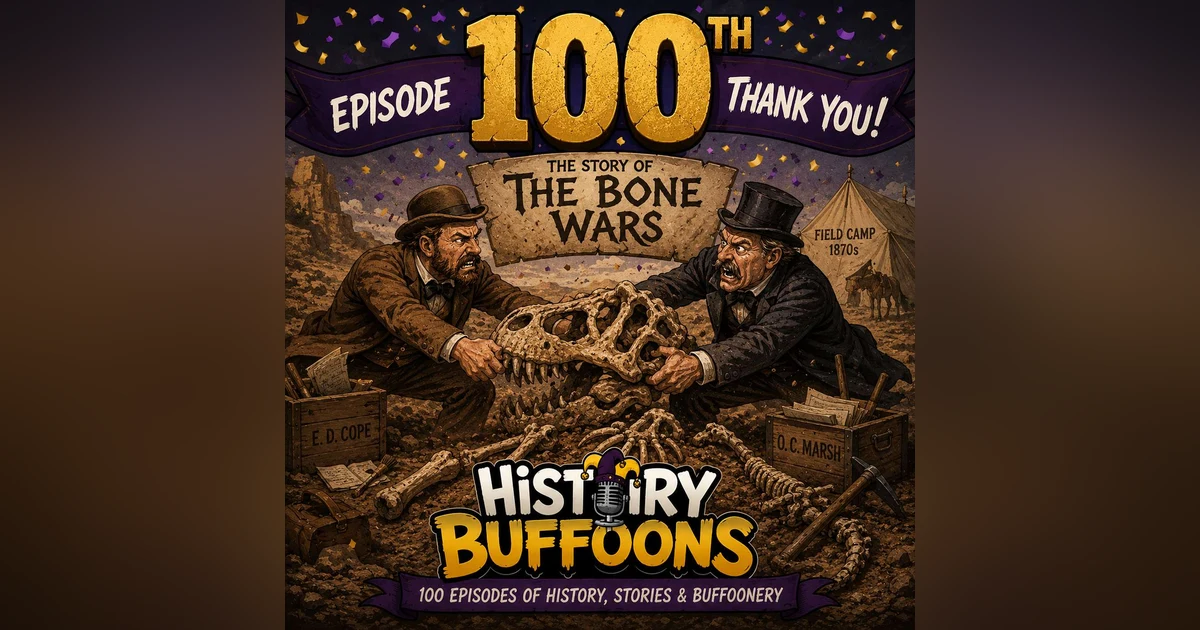
 Episode 100 calls for a toast, but we’re not celebrating with a feel-good story. We’re cracking open a classic beer and digging into the Bone Wars, a late-1800s feud so petty and so destructive that it makes modern internet drama look quaint. Picture the American West baking in the heat, a dinosaur bone surfacing after millions of years, and grown men deciding the best solution is sabotage. Yes, dynamite shows up in this story.
We walk through how Edward Drinker Cope and Othniel Charles Marsh go from professional respect to scorched-earth rivalry. One rushes discoveries into print to claim priority, the other plays it secretive and strategic, and neither can stand sharing the spotlight. Along the way: a backdoor bribe at a New Jersey marl pit, a legendary reconstruction blunder where a prehistoric creature gets its head put on the wrong end, and a fossil gold rush fueled by railroads, coded telegrams, bribed workers, and sites that get reburied or wrecked just to keep a rival from “winning.”
Then the fight leaves the quarries and hits Washington, D.C. and the newspapers, dragging reputations, funding, and the US Geological Survey into the mess. The wild part is the legacy: the Bone Wars help spark discoveries that put Stegosaurus, Allosaurus, Diplodocus, and Triceratops into the public imagination, while also leaving decades of scientific cleanup behind. We even shout out Dinosaur 13 if you want more fossil-world chaos after the credits roll.
If you like strange history, big personalities, and the human side of science, hit subscribe, share this with a fellow history nerd, and leave us a rating and review.
This website contains affiliate links. This means that if you click on a link and purchase a product, I may receive a small commission at no extra cost to you. This helps support the running of this website and allows me to continue providing valuable content. Please note that I only recommend products and services that I believe in and have personally used or researched.
00:00 - 100th Episode Cheers And Teaser
02:06 - What The Bone Wars Really Were
07:55 - Two Paleontologists Built To Clash
15:12 - The Bribe That Broke Friendship
17:18 - Head On The Tail Humiliation
22:09 - Fossil Rush Turns Into Sabotage
36:53 - Politics Newspapers And Mutual Destruction
46:03 - What They Found And What It Cost
100th Episode Cheers And Teaser
SPEAKER_01Oh hey there. Oh hey there.
SPEAKER_02Oh hey there. I'm Kate. I'm Bradley.
SPEAKER_01And this is the History Puffoon. Sound like That's what I was trying to go for.
SPEAKER_02Well, that's what I said. That's why it sounded like that.
SPEAKER_01Well, then I did a good job.
SPEAKER_02How are you today, Kate?
SPEAKER_01I'm doing pretty well. How are you?
SPEAKER_02I am well. We're uh sitting in the podloft. Just knocked my microphone. Microfo.
SPEAKER_01Guess what episode this is?
SPEAKER_02This would be episode 100.
SPEAKER_01Boom!
SPEAKER_02So let's crack a beer to cheers to 100.
SPEAKER_01Crack a beer of our favorite beers.
SPEAKER_02Yeah, we're going with uh we're going with the classics today. Nothing fancy, nothing special, but delish nonetheless. Banquet, it's only made with Rocky Moon water. Can't get it anywhere else made anywhere else, I should say. You can get it everywhere. Delicious. Cheers.
SPEAKER_01Cheers. Happy 100th episode.
SPEAKER_02Happy 100th episode.
SPEAKER_01We are not oh gosh damn. I keep hitting the microphone. Don't do that. This does not count the origin of weird episodes. This is just more full-length episodes.
SPEAKER_02We count we count them a little separate. It's all the same podcasts, but we count them kind of separately. Yeah. So uh this would be episode 141 if we counted them together.
SPEAKER_03Oh dear.
SPEAKER_02But um but no, we we we kind of separate them to a degree because Origin of Weird is just you know our little short form partner to our long form uh history.
SPEAKER_01So well, before we get into too much, I want to tell you
What The Bone Wars Really Were
SPEAKER_01a little bit about what we're gonna talk about today.
SPEAKER_02All right.
SPEAKER_01Have you ever heard of the Bone Wars?
SPEAKER_02The Bone Wars. No, I have not. I don't think so.
SPEAKER_01It it doesn't have death the way you think it does.
SPEAKER_02Okay.
SPEAKER_01It's about two men with gigantic egos.
SPEAKER_02Of course.
SPEAKER_01Who are hunting dinosaur fossils.
SPEAKER_02Oh, sure. Yeah. You know, they're already dead. Yeah. And it's like, I can find this bone better than you, faster than you. Whatever the word. Insert correct word there. Yeah. Than you. Yeah, okay, so okay. Already dead. Let's look for bones.
SPEAKER_01And we're we got egos to go with it.
SPEAKER_02Naturally.
SPEAKER_01Yeah.
SPEAKER_02That's what history is all about is overly sized fucking egos of people who think I am better than the next person.
SPEAKER_00Right.
SPEAKER_02Typically. I mean, that's what a lot of wars are going on.
SPEAKER_00I feel like we need a shot.
SPEAKER_02Fuck, I wish we had one.
SPEAKER_00I know. Damn.
SPEAKER_02If only we had that South Dakota whiskey you got. That was good.
SPEAKER_00I left at home.
SPEAKER_02Yeah. I I enjoyed uh trying that. So thank you for that. That's okay. Like you said, you left it at home. We are currently in the the pod loft. Um happy Independence Day.
SPEAKER_01Yep, it is also July 4th.
SPEAKER_02Yeah, we are recording this on the 4th of July, 250 years to America. Here's uh 250 more.
SPEAKER_01250 and our 100th. So just imagine I already am spending weeks digging through the blistering heat of the American West. I'm out. You're covered in dirt, sweat running into your eyes that happens to you already and on a daily basis.
SPEAKER_02Oh my god, when I'm working.
SPEAKER_01Um, every shovel full of earth brings you closer to something that nobody has seen in millions of years. And then it happens. A bone emerges from the ground.
SPEAKER_02Yes.
SPEAKER_01Not just any bone, but part of a dinosaur, unlike anything ever discovered before. The kind of fossil that could make a career. It could fill museum halls and change what humanity knows about prehistoric life.
SPEAKER_02Right.
SPEAKER_01Most scientists would carefully excavate it, pack it into crates.
SPEAKER_02But this guy's like get this fucker out of here.
SPEAKER_01Well, instead, some men reached for the dynamite. Some crews intentionally damaged fossils, bury reburied sites, and in some cases used dynamite to destroy specimens that they couldn't recover simply bec to keep them out of their rivals' hands.
SPEAKER_02So is it dynomite?
SPEAKER_01Ha ha. I just I just licked my microphone.
SPEAKER_02No, I have to sanitize that. Krouse.
SPEAKER_01It's dynamite.
SPEAKER_02Oh, that's pretty easy. That didn't even cross your mind, did it?
SPEAKER_01It really did not.
SPEAKER_02Oh man.
SPEAKER_01So it might sound completely insane, but it happened during one of the strangest rival rivalries in scientific history.
SPEAKER_02Is this in the 1800s?
SPEAKER_01It is.
SPEAKER_02Yeah.
SPEAKER_01It was a feud so bitter that it involved bribery, spying, public humiliation, sabotage, stolen discoveries, and pettiness.
SPEAKER_02Wow. This sounds epic.
SPEAKER_01And this is the Bone Wars.
SPEAKER_02Is this like 1830s?
SPEAKER_01Um, later than that. It's the late 1800s.
SPEAKER_02Oh, later 1800s.
SPEAKER_01And in fact, I meant to look up one question that I had for myself.
SPEAKER_02Yes.
SPEAKER_01I'm gonna look it up right now.
SPEAKER_02Because for some reason. Okay, I don't know exactly what you're gonna talk about here. I had a feeling, especially with when um dinosaur bones were discovered or whatever. I thought it was the 1830s, but I mean it still could be true. It might just be these people might be looking for it afterwards, but I didn't know it was late 1800s.
SPEAKER_01So I want to bring in Mary Anning.
SPEAKER_02Of course, who we did an episode on.
SPEAKER_01Yes, I don't remember what episode it was.
SPEAKER_02It was called Mary's Comet.
SPEAKER_01It was called Mary's Comet. I believe it was like within the first couple of episodes.
SPEAKER_02It was pretty early on in our uh episode 11.
SPEAKER_01Yeah, episode 11. So Mary Anning was in England and she found a lot of fossils, Ichthyosaurus. Yes, and that was in the mid-1800s.
SPEAKER_02Maybe that's why I'm kind of thinking about it.
SPEAKER_01Um she was it was between like 1823, 1830-ish.
SPEAKER_02Okay, maybe the maybe that's what's going through my brain then. But this is obviously the states.
SPEAKER_01This is the states, you know. So um at first glance, like we're you think we're talking about dinosaurs. Yeah, dinosaurs plays a plays a little role, but this is just entirely about these about two men. Right. Um they are two brilliant scientists with massive egos, and they became so obsessed with defeating each other that they nearly destroyed the science that they claim to love.
SPEAKER_02So uh, that's the beauty of people. They really know how to fuck
Two Paleontologists Built To Clash
SPEAKER_02shit up.
SPEAKER_01Fuck their own shit up. Well, that too. Yeah. So the first gentleman was Edward Drinker Cope.
SPEAKER_02Drinker?
SPEAKER_01Yep.
SPEAKER_02Like that boy's a drinker? Yep. Edward Drinker Cope. Do you think that's why his middle name was that? I don't know. That's an odd middle name.
SPEAKER_01It is. Okay. And he was born into a wealthy Quaker family. And unlike many scientists of this era, he didn't spend his early years worrying about money.
SPEAKER_02Okay.
SPEAKER_01Or trying to secure a position at a university.
SPEAKER_02Yeah.
SPEAKER_01His family's wealth gave him freedom that he used to pursue an obsession with natural history.
SPEAKER_03All right.
SPEAKER_01He was a genuine prodigy. By the age of 18, he had already published scientific papers and was earning a reputation as one of the brightest young minds in American science.
SPEAKER_02Wow, I wish I could say I did that.
SPEAKER_01His bring brilliance did come with some baggage. Oh, always does. Cope was impulsive, competitive, and notoriously hot-tempered.
SPEAKER_02You don't say.
SPEAKER_01He moved quickly, thought quickly, and published discoveries at a pace that left his colleagues kind of stunned.
SPEAKER_02Now, did he publish them properly? Like they were stunned, but like, did he do the right work and everything? No. So he just like, looks good to me. Yeah. Print it.
SPEAKER_01Exactly.
SPEAKER_02Wow.
SPEAKER_01That seems like he didn't review his first draft. Oh.
SPEAKER_02That seems not right.
SPEAKER_01He was the kind of person who always believed that he could find the answer first.
SPEAKER_02So he always rushed to get that answer first. Yes. Even if it was wrong.
SPEAKER_01Yes.
SPEAKER_02And it's not like go go to the internet and fact check me. Correct. Because, well, lo and behold, wait a hundred and some years. Right. So, okay. What a let's learn more before I say anything.
SPEAKER_01So the second man was O thinyl. Othinyl? Othynol. Nope. Othneil. Oh man. Othneil.
SPEAKER_02Othneil. How do you spell that?
SPEAKER_01O T H N I E L. Othneil.
SPEAKER_02Othneil.
SPEAKER_01Mm-hmm. Othneil Charles Marsh. So we got Marsh and we got Cope. Okay.
SPEAKER_02I feel like Oth Neil is like, oh man, I'm I got an Othneel in my knee or something like something like weird, you know, medical. Yeah.
SPEAKER_01Othney. Yeah. Anyway. Marsh's story was um a little bit more different than um Cope. Um, he was born on a modest uh farm in rural New York and spent much of his early life far removed from the wealthy scientific circles that Cope took for granted.
SPEAKER_02All right. Excuse me.
SPEAKER_01If not for a stroke of luck, Marsh might have spent his entire life working the land. But luck came in the form of his uncle, George Peabody.
SPEAKER_02Peabody. It was a common name back then, wasn't it?
SPEAKER_01So Peabody was one of the wealthiest men in America.
SPEAKER_02Oh, okay.
SPEAKER_01And one of the most influential philanthropists of the 19th century. And his money changed everything for Marsh.
SPEAKER_03Oh.
SPEAKER_01Uh Peabody paid for Marsh's education, funded his studies in Europe, and eventually established the Peabody Museum of Natural History at Yale, where Marsh became one of the country's leading paleontologists.
SPEAKER_02Is that uh still the museum is still there?
SPEAKER_01I don't recall if it's named the same thing.
SPEAKER_02That's fine.
SPEAKER_01Yeah.
SPEAKER_02So why did this Peabody take such a liking to Marsh and give him money?
SPEAKER_01Family? I don't know.
SPEAKER_02Okay.
SPEAKER_01That's a part of my research. So unlike Cope, Marsh never felt, never forgot what it felt like to have nothing.
SPEAKER_02Yeah.
SPEAKER_01Where Culp Cope was in impulsive, Marsh was cautious. Where Cope rushed to publish, Marsh preferred to keep his discovery secret until he was absolutely certain. And where Cope wore his emotions openly, Marsh kept his cards close to the vest.
SPEAKER_02So did he wear his emotions on his sleeves.
SPEAKER_01On his sleeve.
SPEAKER_02That's what I'm talking about.
SPEAKER_01The two men approached science in completely different ways. And in hindsight, they almost seemed destined to become enemies, but they did start off as friends.
SPEAKER_02Oh, they did. So they actually knew each other from an earlier age? Yes. So how old were they when they met?
SPEAKER_01So this we're fast forwarding to 1864.
SPEAKER_02It's a good year.
SPEAKER_01So around 24 years old, give or take. Okay. Um, both men found themselves studying in Berlin. And while the American Civil War raged back home, they spent their days exploring museums, discussing fossils, and building what appeared to be a genuine professional relations uh friendship. Okay. They respected each other so much that they even named newly discovered species after one another.
SPEAKER_02Really?
SPEAKER_01Cope honored Marsh by naming a fossil amphibian Anisopus Marshe. While Marsh returned the compliment by naming a marine reptile, Mosasaurus Copanus.
SPEAKER_02So you're telling me basically all these names we got are bullshit because they just might have been named after somebody, not actually scientifically real.
SPEAKER_01Well, those two. I know. I'm just joking.
SPEAKER_02It's just funny because like a lot of things were named honestly that way. Yeah. Because it's not like they would have known the name.
SPEAKER_00Yeah.
SPEAKER_02Like Tyrannosaurus Rex. Yeah. Someone gave it that name. Yeah. Obviously, no Stegosaurus was walking down the road one day and be like, oh, there's a T-Rex over there.
SPEAKER_01Right.
SPEAKER_02So I mean, it's just weird how names come about for things that we have no fucking clue about. Right. And now that we've been calling it that for, well, whatever, 100 years, 150 years, whatever the fuck it's been. So, anyways.
SPEAKER_01Yeah. So naming new species after each other was not a casual gesture. Scientific names can survive for centuries. Yeah. Meaning, ooh, I'm I I moved. Meaning each man was effective ensuring that the other's name would be permanently attached to the history of life on Earth. Right. So for a brief moment, it looked as though American paleontology had gained two talented allies. But tensions were beginning to form.
SPEAKER_02So what caused these tensions?
SPEAKER_01Oh, let me tell you. Please do. That's why I asked. Cope saw Marsh as overly cautious and calculating.
SPEAKER_02And he wanted him to be more just shoot from the hip kind of fucking guy. I mean, that seems stupid though.
SPEAKER_01Marsh saw Cope as reckless and undisciplined. One came from old money. One came from a modest family farm. One trusted his instincts, and the other trusted meticulous planning.
SPEAKER_03Right.
SPEAKER_01So neither men were particularly good at sharing the spotlight. And all they needed was a spark. And that spark arrived
The Bribe That Broke Friendship
SPEAKER_01in 1868 at a fossil site in Haddonfield, New Jersey.
SPEAKER_02Good old Haddonfield.
SPEAKER_01So the relate the friendship between Cope and Marsh may have survived for their differences, their differences if it weren't for 1868.
SPEAKER_03Oh.
SPEAKER_01Cope invited Marsh to visit one of the most important fossil sites in the country, the marl pits of Haddonfield, New Jersey. What are marl pits? Well, marl pits um were they actually dug in these marl pits for fertilizer. It's a type of fertilizer.
SPEAKER_03Oh.
SPEAKER_01So today Haddonfield is famous for being the location where the first reasonably complete dinosaur skeleton was discovered in North America. Okay. It was essentially like a gold mine for paleontologists. Sure. Okay. And because of all the digging for this fertilizer, they regularly stumbled across um all these discoveries, right? Yeah. So to Cope, this was an opportunity to show a colleague around one of his most productive hunting grounds. To Marsh, it was a business opportunity.
SPEAKER_02I I wouldn't have guessed Marsh to be the business opportunity aspect. At least the connotation of it sounds not like it aligns with what he would do.
SPEAKER_01Yeah.
SPEAKER_02Okay, go on.
SPEAKER_01So while visiting the site, Marsh quietly approached the pit operators behind Cope's back and offered them money.
SPEAKER_02Oh shit.
SPEAKER_01If they found any future fossils, they were to send them directly to Marsh at Yale instead of Cope in Philadelphia.
SPEAKER_02Interesting.
SPEAKER_01For Marsh, it was simply securing access to valuable specimens. For Cope, it was betrayal.
SPEAKER_02Yeah, it was backstabbing.
SPEAKER_01And that trust that existed before was suddenly gone.
SPEAKER_02You don't say. Yeah. All right.
SPEAKER_01From that point forward, their relationship became increasingly hostile, and before long, Cope found himself facing an embarrassment that would haunt him for the rest of his career.
Head On The Tail Humiliation
SPEAKER_01Oh shit. In 1868, Cope received the remains of a strange marine reptile, unlike anything scientists have previously discovered.
SPEAKER_03Okay.
SPEAKER_01The animal would eventually become known as Elasomosaurus, and it is one of the most famous prehistoric creatures ever discovered at the time. Okay. The problem was that the skeleton wasn't neatly laid out in the ground waiting to be assembled. It arrived as a collection of disconnected bones, and Cope was eager to reconstruct the creature and publish his findings before anyone else could.
SPEAKER_02And you didn't put it back together, right? You didn't. Imagine that. That was pretty much an easy one to pick.
SPEAKER_01Elosimosaurus possessed one feature that seemed almost unbelievable. His neck was absurdly long. Right. Modern animals simply don't look like that.
SPEAKER_03No.
SPEAKER_01The neck contained more vertebrae than anyone expected, creating a body plan that seemed completely backwards compared to most familiar creatures.
SPEAKER_02So did he put it together wrong because of that?
SPEAKER_01The neck, yeah. So think of a brontosaurus. Yeah. But instead of legs, it has fins.
SPEAKER_02Yeah.
SPEAKER_01And then the tail is shorter.
SPEAKER_02Right.
SPEAKER_01So, working quickly, Cope assembled the skeleton and proudly published his reconstruction. There was just one problem. He put the head on the wrong end. He put it on the tail. He put it on the tail. Yeah. Looking at the pile of bones, Cope assumed the enormous series of vertebras represented a tail.
SPEAKER_02I mean, I can understand, like you had said, that this isn't anything like we've ever seen. So obviously, you know, besides a giraffe, what has a really long neck on the planet? Right. Not a lot of things, honestly. So I can see, you know, tails are gonna typically be longer. Oh, excuse me. So I can see why he might have done that, but like again, this is why he's an idiot for just rushing to I gotta be the first. Who else fucking has this right now? Take take an extra five minutes, dude, and just think it through.
SPEAKER_01So as a result, he attached the skull where the tail should have been and presented the creature to the scientific community with complete confidence. Unfortunately for him, Marsh noticed the mistake almost immediately. And rather than quietly men mentioning the error, Mark, Marsh made sure everyone knew about it. Oh boy. The disagreement became so heated that respected paleontologist of the time, Joseph Leedy, was eventually brought in to settle the matter.
SPEAKER_02Okay.
SPEAKER_01Leedy served as like a neutral expert. When Cope and Marsh were arguing over the reconstruction, Leedy examined the skeleton and concluded that Marsh was correct. Cope had placed the skull on the tail rather than the neck. And what makes this a little bit more painful is that Leedy was one of the most respected scientists in America. He was actually a mentor to Cope. Oh.
SPEAKER_02So Cope completely admired him. So with him siding with Marsh being correct, even though Cope was just wrong, he took that more as a slight because you even fucked up my relationship with my mentor kind of mentality.
SPEAKER_01Yep, exactly. So the embarrassment for Cope was enormous.
SPEAKER_02I would say.
SPEAKER_01So realizing the magnitude of the mistake, Cope desperately tried to recall copies of the scientific publication that contained the incorrect um reconstruction.
SPEAKER_02So like you say it contained the incorrect reconstruction. Was it a drawing then that they released? Because it's I mean, there was photography at this point.
SPEAKER_01There was photography, but I didn't look into what the publication said or anything.
SPEAKER_02Because I'm just curious as to like, you know, how how was it presented in this?
SPEAKER_01I'm assuming it was photos, but you would think. Yeah.
SPEAKER_02But all right.
SPEAKER_01So he hoped to remove the eviden evidence before it spread throughout the scientific community. And of course, Marsh had other ideas.
SPEAKER_02So he kept spreading it.
SPEAKER_01Knowing exactly what Cope was attempt attempting, Marsh made sure the mistake was widely known among the scientific community and referenced referenced it for years afterwards. So if Cope wanted the mistake forgotten, Marsh was determined to make sure it lived forever.
SPEAKER_03Seems that way.
SPEAKER_01Years later, Marsh would openly boast about the incident, writing that Cope's wounded pride had never recovered. Whether that was true or not, we don't know, but for from that moment. For forward, the rivalry the rivalry stopped being professional and it became personal.
SPEAKER_02And it became ridiculous. Wow. Yes. Okay.
Fossil Rush Turns Into Sabotage
SPEAKER_01So following the Civil War, railroads pushed deeper into the American West. Yep. Survey crews blasted through mountains, carved routes uh across the plains, and exposed rock formations that had been hidden for millions of years.
SPEAKER_03Sure.
SPEAKER_01To every new railroad cut seemed to reveal another trevor treasure trove of fossils.
SPEAKER_03Right.
SPEAKER_01To paleontologists, this was like a gold rush. Yeah. Yeah. Because by by the time these discoveries began pouring out of the frontier, Cope and Marsh were no longer interested in simply finding fossils. They were interested in beating each other.
SPEAKER_02And basically sabotaging each other, more or less. Yeah.
SPEAKER_01Yes, they were willing to do pretty much anything to win. So it's important to remember that these expeditions weren't taking place in some peaceful scientific playground.
SPEAKER_03No.
SPEAKER_01It was the American frontier during a period of enormous conflict and expansion. Right. Railroads, military expeditions, settlers, prospectors, native nations, and government survey teams were all competing for control of the same territory. Sure. So scientists often traveled alongside soldiers. Some negotiated directly with native leaders for access to fossil-rich regions. Others relied on military forts for protection and supplies. And the search for dinosaurs was deeply intertwined with a larger story of the Western expansion. Even the way Cope and March Marsh approached these expeditions reflected their personalities. His expeditions were well supplied, carefully organized, and often included teams of students and assistants.
SPEAKER_02Okay.
SPEAKER_01On one journey, he even hired William F. Cody Buffalo Bill as a guide. Did he really? Yeah, isn't that cool?
SPEAKER_02That's weird.
SPEAKER_01Cope's expectations was far less polished. During one trip to Wyoming in 1872, he arrived expecting support from a government survey, only to discover the group had already departed with most of the available transportation and supplies. Rather than turning back, Cope improvised. He assembled whatever crew he could find, secure wagons where he could, and pushed forward west anyway. Oh boy. By this point, neither man was simply collecting fossils. They were racing uh racing each other across an entire continent.
SPEAKER_02Yeah, no kidding.
SPEAKER_01So by the late 1870s, the rivalry have moved has moved far beyond scientific disagreements. At this point, Cope and Mar Marsh aren't trying to make discoveries anymore. They're just trying to beat each other to the discovery. So the moment that either man found something new, even if it was nothing more than a single tooth or a fragment of jawbone, the race began. Specimens were examined as quickly as possible. Brief descriptions were rushed into print, and new species names were announced before anyone had time to carefully verify the findings. The goal was not accuracy in this information, but priority.
SPEAKER_02It was a timely thing.
SPEAKER_01Whoever published first received the credit.
SPEAKER_02They didn't care about being correct. No. They just wanted to get it out first.
SPEAKER_01So as a result, both men began naming species at a staggering pace. Fossils were described from incomplete remains. Animals were sometimes named multiple times because juvenile specimens were mistaken for an entirely different species. In other cases, fossils already described by one scientist received a brand new name from another. It was just scientific chaos.
SPEAKER_02So did a lot of these naming issues and such get corrected over time with other like actual legitimate scientists? Yes. Okay. And I say legitimate scientists not that they weren't, but clearly they abandoned being scientists. Yeah. Just for uh clout? No. Just to fuck the other one. Yeah. Not even clout. Yeah, that could probably came along with it if they published first, compared, you know, if Cope got something out before Marsh did or vice versa.
SPEAKER_00Yeah.
SPEAKER_02But they clearly abandoned all fucking hopes of being actual scientists. Which is really sad because, you know, especially during this time, a lot to be had.
SPEAKER_01Oh yeah. Smorgus bored. Yeah. Smorgus borg.
SPEAKER_02Yes. Or a smorgasbord. You know, I guess.
SPEAKER_01Is it board or borg?
SPEAKER_02I thought it was Borg, but you said Borg first.
SPEAKER_01Yeah, and then I said Borg.
SPEAKER_02I know.
SPEAKER_01Somebody correct us.
SPEAKER_02When I think of Borg, I think of the next generation Star Trek because the Borg, we are Borg. That's what, anyways.
SPEAKER_01So dozens of duplicate and invalid names flooded the scientific literature, creating a mess that future paleontologists would spend decades trying to untangle.
SPEAKER_03Yeah.
SPEAKER_01The feud became so disruptive that editors of The American Naturalist, one of the country's leading scientific journals, eventually grew tired of the constant stream of over overlapping claims and personal attacks. Editors grew increasingly frustrated with the disputes, the criticisms, and complete the competing claims that accompany the rivalry.
SPEAKER_02Well, and maybe you get to this, maybe you don't, but at what point do these people be like, hey, if um anything comes across your desk from Copern Marsh, don't do anything with it. You know what I mean? Yeah. Because like clearly they're there's they're not doing the work. Yeah. They're just skating by to try and beat one another, whether they knew that was the case or not. But it was like, hey, I got this new uh thing from Marsh, put it in the round receptacle over there.
SPEAKER_01Right. Well, I bring up the the journal again here in a moment. Right. For most scientists, that would have been at the end of the argument, but for Edward Cope, it was simply an obstacle. So in 1877, Cope acquired a controlling interest in the American Naturalists magazine or journal.
SPEAKER_03Oh boy.
SPEAKER_01Giving him significant influence over one of the country's leading scientific journals. It was the 19th century equivalent of purchasing your own television network because you didn't like the coverage.
SPEAKER_02How I know he came from older money, but is that how he got the interest in it? Okay.
SPEAKER_01So with his new acquisition, uh Cope gained a platform where he could publish his discoveries and criticize his rivals without worrying about editorial interference.
SPEAKER_02Oh dear.
SPEAKER_01And of course, the rivalry was about to become even more absurd.
SPEAKER_02Right.
SPEAKER_01In 1877, marked the point where the rivalry entered its most intense phase. That year, several discoveries in Colorado and Wyoming revealed something extraordinary. Scientists had been finding prehistoric mammals for years, but these sites contained something a little bit more spectacular. Entire graveyards filled with gigantic Jurassic animals, unlike anything previously discovered in North America. Right. Ironically, neither Cope nor Marsh made the initial discoveries. Of course. One of the most important finds came from Arthur Lakes, a school teacher and amateur geologist near Morrison, Colorado.
SPEAKER_02I know of Morrison, yeah.
SPEAKER_01And while exploring local rock formation, uh Lakes noticed enormous fossil bones protruding from the hillside. Right. Unsure exactly what he had found, he collected specimens and contacted professional paleontologists for help. Unfortunately, he reached out to both Coke and Marsh.
SPEAKER_02So how did he reach out to them? Like not anyone else? I mean, you can't tell me those were the only two.
SPEAKER_01I'm sure he reached out to a couple, but it just happened to be also those two.
SPEAKER_02Yeah.
SPEAKER_01Because they still have a name for themselves.
SPEAKER_02Well, at this point, because even though they're trying their darndest to tarnish their own fucking names, but all right.
SPEAKER_01So the moment each man realized the other had been informed about the same fossil site, panic set in. Agents were dispatched across the West, exclusive agreements were negotiated, digging rights were secured, and before long both sides were employing tactics that looked remarkably similar to industrial espionage. Oh boy. Marsh in particular became obsessed with secrecy. He occasionally used coded telegrams and other secrecy measures to conceal discoveries from rivals.
SPEAKER_02Do you have any like uh examples of okay? Never mind. I'll just grab a beer.
SPEAKER_01Rival scientists were rarely mentioned by name, fossil sites received code words, shipping routes were disguised, information was compartmentalized so thoroughly that some workers barely even understood the larger operation that they were participating in.
SPEAKER_02Yeah, they're basically in the dark about it.
SPEAKER_01Both camps regularly attempted to steal information from the other.
SPEAKER_02Good lord.
SPEAKER_01Workers were bribed, crews would switch sides, digging locations would be leaked. Both sides paid close attention to fossil shipments in transportation routes.
SPEAKER_03Okay.
SPEAKER_01Some reports even describe rival crews engaging in fist fights and throwing rocks at one another while competing access for fossil rich hillsides.
SPEAKER_02So do you find it odd that even their feud trickled down to the people that worked for him? Oh, yeah. I mean, holy fuck, what kind of pull do you have on the people that were? Hey man, I work for Marsh. I work for Cope. Fuck you. It's like If my company had a feud with a rival vending machine company, I'd be like, good for you. I'm gonna go do my shit. Yeah. I don't give a fuck.
SPEAKER_01Well, they're also being bribed.
SPEAKER_02Which doesn't help because obviously Marsh is bribing Cope's people, and Cope is doing the same to Marsh's people, and they're flipping sides because ooh, I got an extra nickel today from Marsh. I'm gonna go work for this guy. Right. Or whatever fucking bullshit it was. But yeah, I mean, obviously they're being coerced into nefarious things. We'll just say that.
SPEAKER_01Yeah. So because eventually women winning became more important than science itself, if Mars's crew uncovered fossils that they couldn't transport, they were sometimes ordered to destroy them.
SPEAKER_02Isn't that wild? Just think of how many fucking fossils were lost because of that. Yep. Like, just to not let someone else get them. You piece of shit. And just like, hey man, um, we don't have enough room on our cart, blow it up.
SPEAKER_01Yeah.
SPEAKER_02Fuck you.
SPEAKER_01So in some cases, fossils that could not be recovered were intentionally damaged, buried, or left vulnerable to destruction rather than risk falling into the rival's hands.
SPEAKER_02So can you describe what being left vulnerable to destruction means?
SPEAKER_01Um no. I mean, left uncovered and I don't know.
SPEAKER_02Just got sunbleached? I mean, oh yeah, totally sunbleached. Got sunburned, didn't put on enough sunscreen.
SPEAKER_01Later accounts also describe the use of explosives as certain sites. Dynamite. Um, eve eve excavation trenches were deliberately refilled. And when a quarry had been worked to exhaustion, explosives were occasionally used to collapse sections of the site, sure. Burying any remaining fossils beneath tons of rock and rubble.
SPEAKER_02But see, like, why would you do that? Because then you know where those are. You would have to go dig them back up if they even survived the blast for that matter.
SPEAKER_01Do you remember the um discovery of Tutankhamons? Mm-hmm.
SPEAKER_02Where they had to re-bury it?
SPEAKER_01Yeah, they would re-bury it every day or something.
SPEAKER_02It was in every season.
SPEAKER_01Oh, every season. I think it was either way.
SPEAKER_02Yeah. Which okay. I get that. But they also weren't dynamiting the whole fucking thing and blowing shit up. Couldn't you have just, I don't know, hey, I'll pay you this amount of money, get some bullets, and sit here for the next six months or some shit.
SPEAKER_01Or they could take what they could and they can leave the leftovers, you know, for the other guys. Like, you can have my leftovers, that's fine.
SPEAKER_02And you could you could have literally used that as like a fucker kid. Yeah, yeah. Couldn't even find his own shit. He had to take my leftovers.
SPEAKER_01Exactly.
SPEAKER_02What a piece of shit. Am I right? I don't know. I just seems weird to do it that way, but yeah, like I I know I remember that where they had to rebury the Tutan Common site and everything. But I almost understand that.
SPEAKER_01Yeah.
SPEAKER_02This I don't.
SPEAKER_01No.
SPEAKER_02I don't know. Because it was the same people who went back every time for Tutankhamun. Yeah, it was. Anyways, yeah.
SPEAKER_01So Cope and Marsh reflected the era in which they lived. It was the Gilded Age, uh, the age of monopolies. Um, industrial titans fought to dominate railroads, steel, banking, and oil.
SPEAKER_02So the did they not pass go?
SPEAKER_01So for men like Rockefeller and Connornie, success meant controlling resources. For Cope and Marsh, the resource happened to be knowledge. Every fossil represented a pr um prestige, every discovery represented influence, and every scientific victory represented status. Right. And every success achieved by the other man felt like a personal defeat.
SPEAKER_02What a what a way to live life. Yeah. You couldn't just be like, and you don't even have to be happy for the other person, but just focus on your own shit, man. Jesus Christ.
SPEAKER_01So by the 1880s, the battlefield began to shift
Politics Newspapers And Mutual Destruction
SPEAKER_01a little bit. Oh the fighting was no longer taking place solely in dusty quarries and remote railroad towns. It was moving to Washington, D.C.
SPEAKER_02Oh, good place to go.
SPEAKER_01Marsh was about to gain an advantage that Cope could not easily overcome. While Cope continued spreading enormous sums of his own money on expeditions, fossil purchases, and publications, Marsh focused on building political power.
SPEAKER_02Oh.
SPEAKER_01He formed a close relationship with John Wesley Powell, the famous explorer of the Grand Canyon and one of the most influential figures in American science. When Powell rose to leadership within the United States Geological Survey, Marsh benefited enormously. Soon he secured a prominent position within the Federal Scientific Establishment and gained significant influence over government paleontology programs.
SPEAKER_02Smooth move there, buddy, because fucking hell.
SPEAKER_01For the first time, Marsh possessed something even more powerful than personal wealth. He had institutional backing. Yeah. That support allowed him to steer resources towards his own projects while limiting opportunities for his rival. To cope, it felt like being slowly squeezed out of the profession he helped build. Then came an even more aggressive move. Questions soon emerged about who actually owned many of the fossils being collected in the American West. During the 19th century, the rules sound uh surrounding fossil ownership were often vague, especially when discoveries were made during government-funded geological surveys. Marsh and his allies argued that specimens collected with government resources, transportation, or personnel should belong to the federal government and its institutions rather than individual scientists. Since Cope had occasionally worked alongside government survey teams and benefited from their support, critics claimed that at least some of their fossils in his enormous enormous private collection should have been turned over to public institutions such as the Smithsonian.
SPEAKER_02So he basically just did that knowing that Cope had worked with the government on some of these projects to make him lose some of his personal. Wow. So if successful When you first described Marsh. You thought he was like the good. You thought he was the good guy. Yeah. I'm not saying Cope's good. And like what I I don't remember who always says this, but basically, you always say when you hear a story, there's a good person and a bad person. Yeah. Sometimes there's two bad. No one's good. There's two bad here. There's one bad, one worse. Yep. Marsh is starting to be a little worse in my book. Let's see if he redeems himself or cope fucks up even more.
SPEAKER_01So if successful, the claim could have stripped Cope of much of his life's work. Fortunately for Cope, he kept records. As rushed as he is, he actually kept records, receipts, ledgers, travel documents, purchase agreements, years of carefully organized paperwork. Okay. When challenged. Yeah. When challenged, Cope produced enough documentation to demonstrate that most of the fossils had been acquired through his own privately funded expeditions.
SPEAKER_02Okay, but you said most of. So were some done the way that Marsh applied? So they just said this isn't worth our time, more or less.
SPEAKER_01But the damage was already done. Cope was financially exhausted, professionally isolated, and convinced that Mark had or Marsh had orchestrated the entire effort. So for years he had been fighting a scientific rival. Now he believed he was fighting an enemy, and he was prepared to strike back.
SPEAKER_03Oh boy.
SPEAKER_01By the end of the 1880s, the Bone Wars had consumed nearly every aspect of Edward Cope's life. For years he had been quietly collecting ammunition against Marsh, compiling every rumor, every complaint from former employees, every alleged mistake, and every accusation he could find.
SPEAKER_02And he would have Cope would have been 40 in 1880, if I remember right. You said 1840 he was born?
SPEAKER_01Yes.
SPEAKER_02Okay.
SPEAKER_01Yes. So the growing collection became so extensive that Cope reportedly gave it its own name, like the just the research, his own name, Mariana. Historians aren't sure why he chose that name, because like sometimes they'll name trains and ships, female names, you know, that kind of stuff. But um, by the end of the 1880s, it had become a weapon he was uh preparing to unleash on Marsh. Wow. Yes. In January of 1890, he finally decided to use it. He unleashed Mariana? Yes. Rather than continuing the fight through scientific journals, Cope took his accusations directly to the public. Working with journalist William Jose Balo, he helped publish a sensational expose in the pages of the New York Herald, one of the most widely read newspapers in America.
SPEAKER_02At that time, yeah.
SPEAKER_01And the article landed like a bomb. Readers were greeted with headlines describing bitter warfare among America's leading scientists. Cope accused Marsh of taking credit for discoveries made by field workers. He accused him of scientific incompetence. Most damaging, he accused Marsh and his ally John Wesley Powell of mismanaging government funds through the United States Geological Survey. Wow. Suddenly, a feud that had simmered within scientific circles for decades was splashed across newspapers for the entire country to see. And of course, the public loved it.
SPEAKER_02Well, yeah, it was it was juicy gossip. It was.
SPEAKER_01It was the era of sensational journalism. It's like the Kardashians of the 1890s. The story had everything people wanted powerful men, personal grudges, accusations of corruption, and public humiliation. Wow. But of course, Marsh responded immediately. Well, he has to. Using the same newspapers, he published lengthy rebuttals and counterattacks. Then he reached for the weapon that he knew would hurt Cope the most. The Elasa the Elasomo Gosh, why can I not say it? Elasmosaurus mistake.
SPEAKER_02The head on the butt?
SPEAKER_01Elasimorus Elasomorosaur.
SPEAKER_02Why don't you leave it where you left it? Let's just move on.
SPEAKER_01Elasomosaurus. There we go.
SPEAKER_02Oh my god. That took forever.
SPEAKER_01Elasomosaurus mistake. Yeah. So head on the butt. More than 20 years had passed. Since Cope accidentally placed the head on the wrong end of the skeleton. Jesus Christ. But Marsh J. Dragged the story back into the spotlight and presented it as proof that his rival was careless and unreliable.
SPEAKER_02So, I mean, in Marsh's I don't want to really defend him because he seems like kind of like a dick, to be honest. Um, in his defense on this, though, you you have this Cope attacking Marsh, obviously, in the papers, but then it's like, hey, this is actually something he did. Why are you gonna believe him? Right. He couldn't even find out where the head went on this dinosaur. Right. Are you gonna believe him on everything? Yep. You know, and that that's a that's a wicked blow from Marsh back to Cope, then because Cope can't refute that. He fucked it up because he's impatient and rushed that shit out. So well.
SPEAKER_01So soon the two men were publicly accusing each other of incompetence, dishonesty, and corruption while the entire country watched. Right. And of course, the scientific community was absolutely horrified. Sure. The consequences quickly extended beyond personal embarrassment because COPE's accusations had involved federal money. Yep, cong Congress began paying attention. Sure. Lawmakers launched investigations into the United States Geological Survey and started scrutinizing the agency spending. Marsh's extensive government-funded publications became an easy target.
SPEAKER_03Right.
SPEAKER_01One Congressman openly mocked a major paleontol paleontological work about prehistoric birds with teeth, questioning why taxpayers should be funding such research in the first place. So the criticism gained traction.
SPEAKER_02Makes sense.
SPEAKER_01The funding was reduced, budgets were cut, and Marsh's influence within the federal scientific establishment began to crumble. In the end, neither man emerged victorious.
What They Found And What It Cost
SPEAKER_01After decades of warfare, they had largely succeeded succeeded in destroying one another. Cope spent enormous sums funding expeditions, purchasing fossils, and publishing papers. Marsh spent equally staggering amounts building collections, financing excavations, and defending his position. Both reputations suffered, both careers were damaged. Both men saw much of their wealth consumed by the rivalry and the enormous cost of their scientific work.
SPEAKER_02Right.
SPEAKER_01The feud that had started with a secret bribe in in New Jersey had become one of the most destructive rivalries in scientific history. Edward Cope died in 1897 at the age of 56.
SPEAKER_02Wow, I say he's pretty young.
SPEAKER_01Years of field work and chronic health problems had taken their toll, his toll, their toll. Disfortune was gone. His marriage had collapsed.
SPEAKER_02Oh, he was married at this time too.
SPEAKER_01He spent his final years surrounded by the fossils, notebooks, and specimens that had consumed so much of his life. His poor wife. Yet even at the very end, he could not resist one final challenge.
SPEAKER_02Oh, nice.
SPEAKER_01In his will, Cope requested that his brain be preserved and weighed after his death. Like many educated people of the 19th century, he believed brain size was linked to intelligence. It's not. His challenge was directly squared at Marsh. According to later accounts, Cope hoped his pres preserved brain would eventually be compared with Marsh's.
SPEAKER_02Of course.
SPEAKER_01Reflecting his belief that brain size was linked to intelligence. It's not. He won one final competition, one lens chance. When Marsh died just two years later in 1899, he declined and the contest remained unfinished.
SPEAKER_02Nice.
SPEAKER_01Ironically, Marshall's final years looked very similar to Cope's.
SPEAKER_02Oh, really?
SPEAKER_01Despite inheriting substantial wealth and enjoying decades of professional success, he too died with much of his fortune depleted by his lifelong obsession with paleontology. For all their differences, the two men ultimately arrived at remarkable similar endings.
SPEAKER_02Isn't it wild?
SPEAKER_01Both had spent decades pursuing fossils with almost obsessive determination.
SPEAKER_02Yeah.
SPEAKER_01Both had sacrificed four fortunes in the process. Both watched their reputations suffer as the feud spiraled out of control. Which is wild. In many ways, the thing that granted their place in history was not simply the dinosaurs they discovered, but the rivalry that consumed so much of their lives.
SPEAKER_02It was more the the the rivalry than than it was their accomplishments, because I never fucking heard of them. I'm not saying that means anything because I I haven't heard of a lot of fucking people, but the point is the fact is the reason why we're doing a story on them isn't because of what they did to a degree. It's what they did to each other.
SPEAKER_01To each other, yeah.
SPEAKER_02It's just fucking wild.
SPEAKER_01So before Cope and Marsh began their rival rivalry, only a handful of dinosaur species had been identified in North America.
SPEAKER_03Yeah.
SPEAKER_01By the time they died, that number had exploded. Sure. The Bone Wars produced some of the most famous dinosaurs ever discovered, including Stegosaurus, nice, Allosaurus, Diplodocus, and Triceratops.
SPEAKER_02Oh, nice. Okay.
SPEAKER_01Museums filled with specimens. Scientific collections expanded dramatically. The United States emerged as one of the world's leading centers of paleontologic paleontological research.
SPEAKER_03Sure.
SPEAKER_01The modern study of dinosaurs was built largely on the foundations that they created. At the same time, their rush to publish created countless mistakes that scientists spent decades correcting. Species were duplicated, reconstructions were wrong, confusion spread through the scientific literature. The bone wars advanced science and damaged it at the same time.
SPEAKER_02Isn't that wild?
SPEAKER_01And that is the bone wars.
SPEAKER_02So doesn't it frustrate you knowing that most fossils, like you'll go to a museum and it's like, look at this T-Rex, just for example.
SPEAKER_01Yeah.
SPEAKER_02And like 90% of it's fake.
SPEAKER_01Yeah, they're they're replicas. A lot of them are replicas, yeah.
SPEAKER_02That's kind of horseshit.
SPEAKER_01Yeah.
SPEAKER_02I would rather see an incomplete skeleton than a fake one. Yeah. Personally. And it's kind of depressing that that's the case. And I I'm gonna blame Copen Marsh for that.
SPEAKER_01So there is a movie about this? No. Oh. Called Dinosaur 13 from 2014. It's an award-winning documentary and it covers the 10-year legal battle over Sue the T-Rex's skeleton from Chicago.
SPEAKER_02From the Field Museum.
SPEAKER_01From the Field Museum. I highly recommend it. I've seen it.
SPEAKER_02Did you watch it?
SPEAKER_01Mm-hmm. I highly recommend it. It's super, super good. Dinosaur 13. I would like to watch that.
SPEAKER_02I kind of want to go have a pseudo-su now.
SPEAKER_01Ooh.
SPEAKER_02Fucking banquet. I'm just kidding. I'm liking my banquet. Now I want a pseudo-soo.
SPEAKER_01Yeah, so happy 100th episode of the history of the five.
SPEAKER_02Congrats to you and Mossel. Yeah. I do take part in this. But uh yeah, I'd say cheers, but I'll still cheers you.
SPEAKER_03Cheers.
SPEAKER_02Cheers to a hundred. Um cheers to another hundred, and hopefully people enjoy this as much as we do. Welp.
SPEAKER_01I suppose.
SPEAKER_02Alright, buffoons. That's it for today's episode.
SPEAKER_01Buckle up because we've got another historical adventure waiting for you next time. Feeling hungry for more buffoonery? Or maybe you have a burning question or a wild historical theory for us to explore?
SPEAKER_02Hit us up on social media. We're History Buffoons Podcast on YouTube, X, Instagram, and Facebook. You can also email us at History Buffoons Podcast at gmail.com. We are Bradley and Kate, music by Corey Akers.
SPEAKER_01Follow us wherever you get your podcasts and turn those notifications on to stay in the lube.
SPEAKER_02Until next time, stay curious and don't forget to rate and review us.
SPEAKER_01Remember, the buffoonery never stops.